
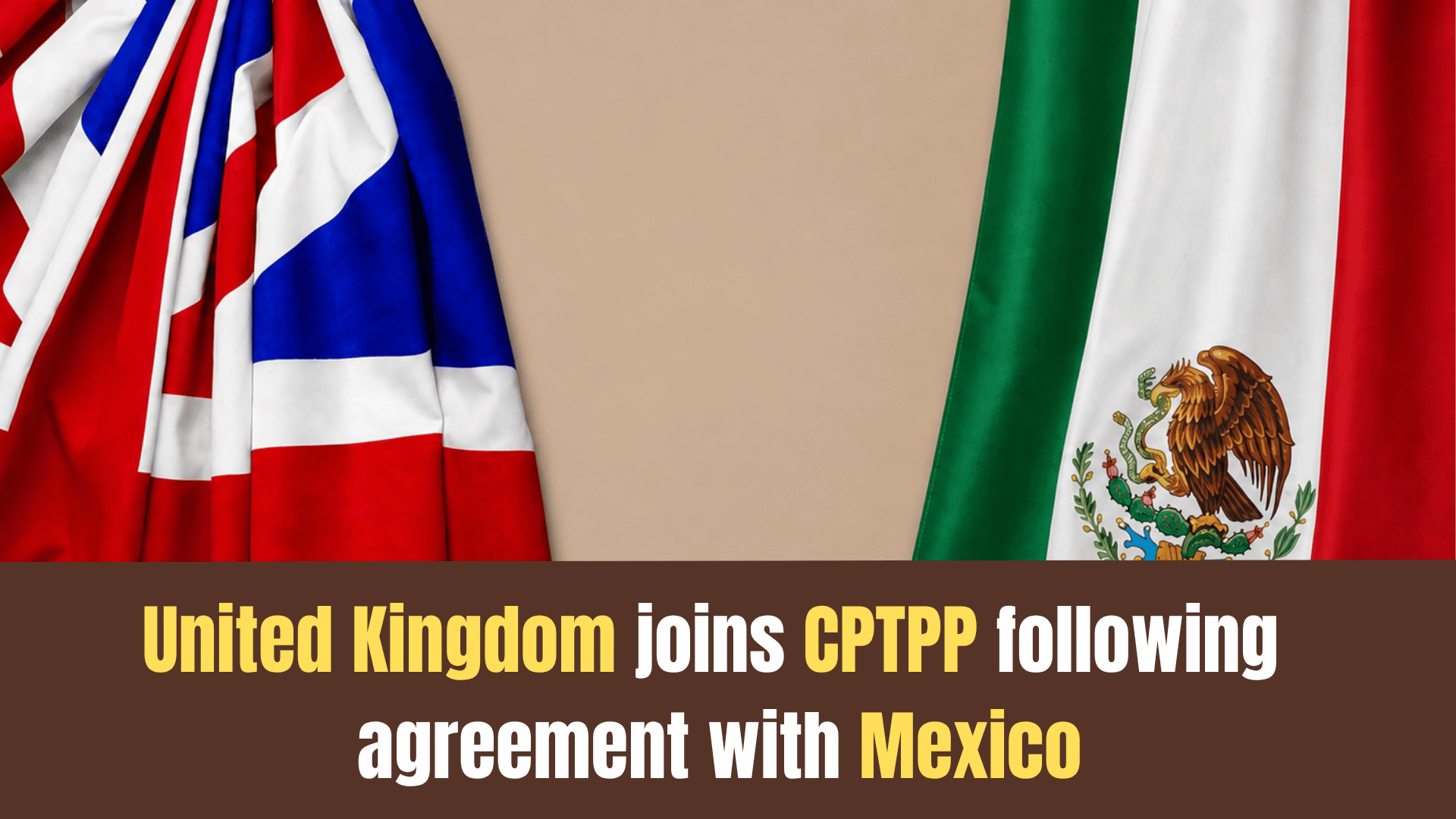
Something significant happened on 22 June 2026 that received far too little attention in the business press.
Mexico formally activated trade provisions with the United Kingdom under the Comprehensive and Progressive Agreement for Trans-Pacific Partnership (CPTPP). In plain terms, this means that, for the first time, UK and Mexican businesses are operating under a shared multilateral trade framework that covers preferential tariffs, modern digital trade rules, and supply chain integration provisions that the older bilateral agreement lacked.
The bilateral trade relationship between the UK and Mexico was already worth US$6.293 billion in 2025. That number is about to grow, and the businesses that understand the new rules first will be positioned to capture the most from it.
Here is what you actually need to know.
Why is this bigger than it sounds
The CPTPP is not just a deal between the UK and Mexico. It is a bloc of 12 economies spanning the Pacific Rim, including Australia, Japan, Singapore, Vietnam, Chile, Canada, Malaysia, Peru, New Zealand and Brunei, with a combined GDP of £12 trillion. That represents roughly 15% of global economic output.
When the UK formally joined CPTPP as a member in December 2024, most of those existing member countries had already ratified the UK’s accession, meaning preferential trade terms kicked in bilaterally with those countries on that date. Mexico was the notable holdout, with ratification pending since January 2026, and it was finally completed last month.
The reason this matters to business owners is the cumulative effect. One of the CPTPP’s most underappreciated provisions is that content from any member country can count toward the origin threshold required to qualify for preferential tariffs. That means a UK manufacturer using components from Japan or Singapore, combining them with Mexican inputs, and selling into the broader CPTPP market can now structure that supply chain to qualify for preferential treatment across multiple legs of the journey. That is new flexibility that did not exist before 22 June.
The UK government expects exports to CPTPP member countries to increase by 65% by 2030, and Mexico’s addition to the active framework is a material part of that projection.
The sectors with the most to gain right now
Not every business will feel this equally. The sectors with the most immediate benefit are worth naming specifically because the impact is not evenly spread.
Automotive and aerospace. Over 2,000 British companies already operate in Mexico across automotive, aerospace, pharmaceuticals and energy. Mexico produces 4 million cars annually, is the sixth-largest automotive producer globally, and ranks first in Latin America. Under CPTPP, duties on vehicles, auto parts and industrial machinery are being progressively reduced, and the cumulation provisions allow Mexican and British content to count jointly toward preferential thresholds. For manufacturers running cross-border supply chains in these sectors, the economics of production and export shift meaningfully.
Food and drink. The numbers here are concrete and immediate. Chocolate tariffs are being cut to 0%, down from up to 25% under the previous framework. UK cheese and dairy products gain duty-free access through shared quotas. Pork exports from the UK to Mexico are subject to zero tariffs from day one. On the import side, UK businesses sourcing Mexican honey, asparagus, sweetcorn and orange juice will also see input costs reduce. The Food and Drink Federation has described this as a genuine step-change for British exporters, particularly smaller manufacturers who previously found the tariff burden made Mexico commercially marginal.
Technology and digital services. This is the area that often gets overlooked in trade agreement coverage because it does not show up as simply as tariff numbers on a spreadsheet. The CPTPP includes modern provisions on e-commerce, cross-border data flows and digital services that the UK-Mexico Trade Continuity Agreement, which has been in place since 2021, never addressed. For UK technology companies, professional services firms, and fintech businesses looking at Mexico as a market, this is the framework that provides legal certainty for cross-border digital trade, something that did not exist before.
Renewable energy. Mexico is actively transitioning toward greener energy and has significant demand for solar panels, wind turbines, battery storage systems and specialised equipment. CPTPP tariff reductions apply to many of these product categories, giving UK energy firms a more competitive cost position than they had under the older bilateral agreement.
Two frameworks running at once and why that matters
Here is something that trips up many businesses when they first look at it. The UK-Mexico Trade Continuity Agreement has not gone away; it continues to operate in parallel with the CPTPP provisions that came into force on 22 June.
What this means in practice is that businesses now have a choice. For any given product category, you can use whichever framework offers the lower tariff rate. That sounds straightforward, but it requires you to actually check both schedules rather than assuming one is universally better than the other. The rules of origin requirements differ between the two agreements as well, so the framework that wins on tariff rate may require different documentation or a different content threshold to qualify.
This also means that the CPTPP does not replace the need for careful tariff analysis. It adds options. Getting those options right is where professional advice pays for itself, particularly for businesses moving goods at scale.
What to watch and prepare for
Two practical loose ends are worth flagging for businesses ready to act, because both affect how quickly preferences can be used.
First, Mexico’s internal decree specifying the applicable import tariff rates for UK-origin goods under CPTPP had not been published as of late June 2026. The bilateral activation is confirmed, but the implementing legislation that sets out whether the immediate tariff exemption applies to all products or whether a phased schedule applies, as it did for Vietnam, is still being finalised. Businesses should monitor announcements from Mexico’s Secretaría de Economía and prepare their documentation in advance, so they are ready to claim preferences as soon as the decree is published.
Second, origin certification for UK exporters will likely operate on a self-certification basis, consistent with the approach used by other CPTPP members that have already ratified British accession. This means UK producers issuing their own certificates of origin rather than relying on a government-issued document. Getting the paperwork right from the start avoids delays and ensures claims hold up under customs scrutiny.
A full bilateral UK-Mexico Free Trade Agreement is also still being negotiated separately, though progress has been slow since negotiations began in 2022. When that deal eventually concludes, it will address digital services, electromobility and creative industries provisions that neither the TCA nor the CPTPP fully covers. The CPTPP is not the end of the story for this trading relationship. It has been the most significant development so far.
The opportunity window is open now
The businesses that move quickly to understand which of their product categories benefit, how to structure their supply chains to maximise cumulation advantages, and how to get their origin documentation in order will capture the early gains. Those who wait for more certainty often find that the most commercially attractive opportunities have already been taken.
At C2Z Advisory, we work with business owners navigating exactly this kind of structural trade shift, from understanding which framework applies to a specific product to thinking through how the UK-Mexico corridor fits into a broader international growth strategy. If the CPTPP activation is relevant to your business, get in touch and let us work through the specifics with you.